
Television has changed more in the last decade than it did in many years before. People no longer depend only on cable lines, satellite dishes, or fixed broadcast schedules to watch their favourite programs. Today, viewers want flexibility, better picture quality, live channels, movies, sports, series, and on-demand entertainment on the devices they already use every day. This is where IPTV becomes an important part of modern digital entertainment.
IPTV stands for Internet Protocol Television. In simple terms, IPTV is a way of delivering television content over the internet rather than through traditional cable, antenna, or satellite signals. It allows users to watch live TV channels, video-on-demand content, time-shifted programs, and other multimedia services using broadband internet.
What Is IPTV?
IPTV, or Internet Protocol Television, is a television delivery system that uses internet protocol networks to transmit video content. Unlike traditional television, which transmits signals via cable wires, satellite transmission, or terrestrial broadcast towers, IPTV delivers television content over an internet connection.
In traditional TV, channels are broadcast continuously, and the viewer simply tunes in to one of them. IPTV works differently. It can deliver content directly to the user when requested. This makes IPTV more interactive, flexible, and personalized than older television systems.
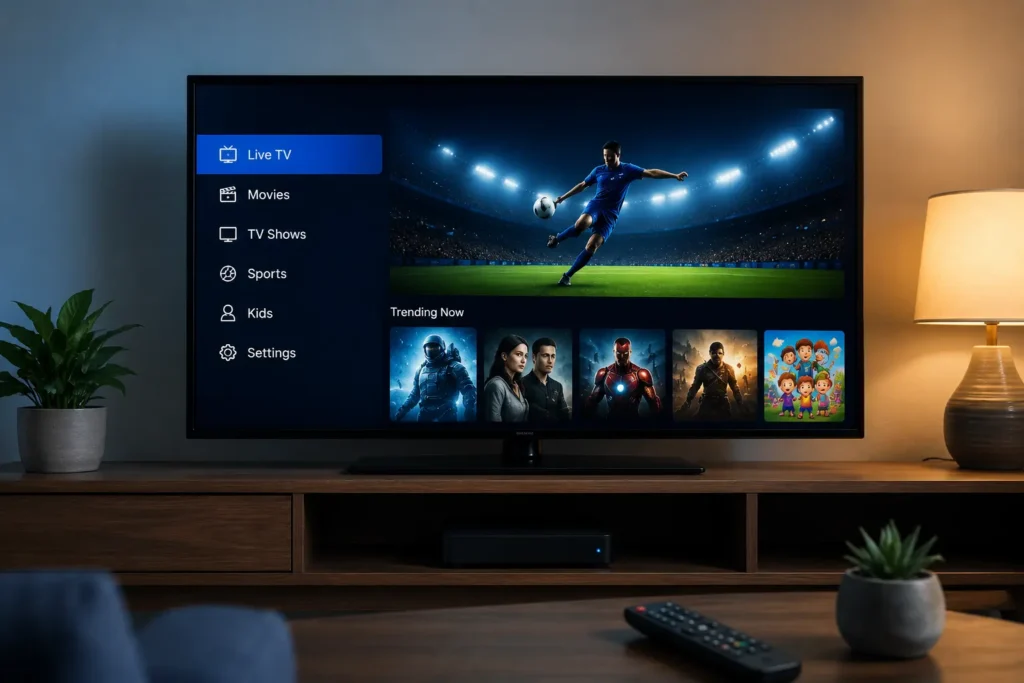
For example, with traditional cable TV, you may have to watch whatever is currently airing. With IPTV, you may be able to watch a live football match, pause a program, replay a missed show, or select a movie from a video library. This depends on the IPTV service, device, internet speed, and available features.
How Does IPTV Work?
IPTV works by converting television signals and video content into digital data packets. These packets travel through an internet connection and are then reassembled on the user’s device as a smooth video stream.
The process sounds technical, but the basic idea is simple. The IPTV provider receives or stores video content, prepares it for internet delivery, and sends it to viewers through servers and streaming technology. The viewer uses an IPTV app, set-top box, Smart TV, or media player to access that content.
A typical IPTV system includes several important parts:
First, there is the content source. This may include live TV channels, movies, TV shows, sports channels, news channels, entertainment programs, or recorded content. The provider collects or manages this content and prepares it for streaming.
Second, the video content is encoded. Encoding means the video is compressed into a digital format that can travel efficiently over the internet. Without compression, video files would be too large and difficult to stream smoothly.
Third, the content is stored or delivered through servers. These servers handle user requests and send the right stream to the right viewer. For video-on-demand, the content is usually stored in a media library. For live TV, the stream is delivered in real time.
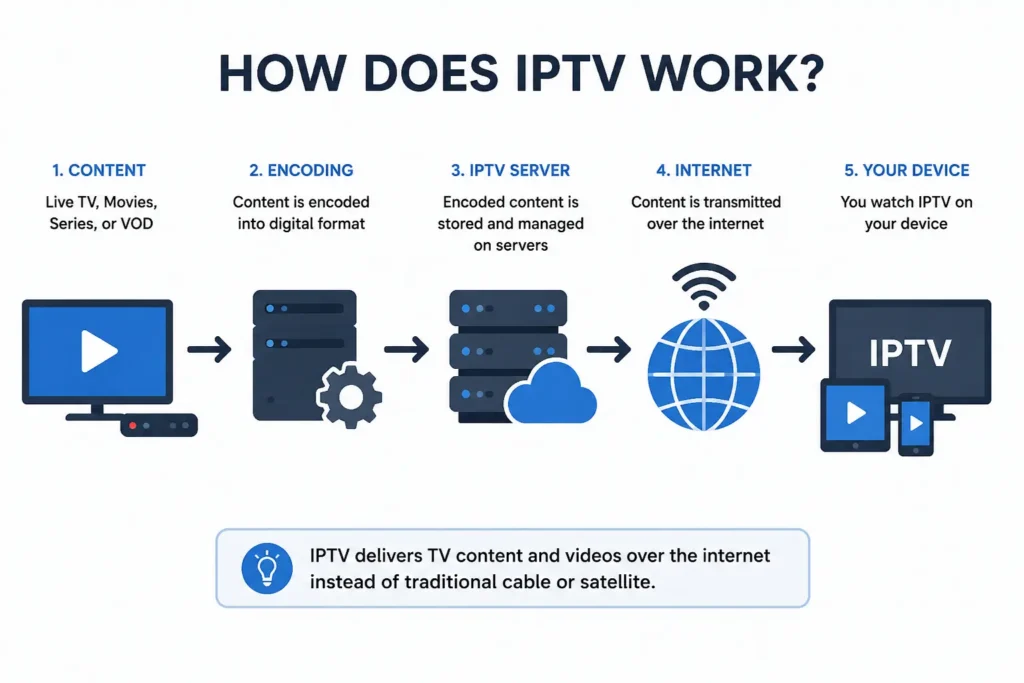
Fourth, the user connects through an IPTV application or device. This can be a Smart TV app, Android box, MAG box, Fire TV device, Apple TV, smartphone app, tablet, computer, or another compatible streaming device.
Finally, the video appears on the user’s screen. The IPTV app or player receives the stream, decodes it, and displays it as live TV, a movie, a series episode, or another type of video.
The Journey of a Video Stream
To understand IPTV better, imagine the full journey of a video stream from the provider to the viewer.
A live TV channel or video file first enters the IPTV system. The video is processed, compressed, and converted into a streaming format. Then it is sent to a server or content delivery network. When a user opens the IPTV app and chooses a channel or movie, the system receives that request. The server then sends the selected stream to the user’s device through the internet.
The device does not usually download the full video at once. Instead, it receives small portions of video data continuously. This is called streaming. As long as the internet connection is stable and fast enough, the video plays smoothly.
This is why internet speed is so important for IPTV. A weak or unstable connection can cause buffering, freezing, low-quality playback, or delays. A good IPTV experience usually depends on a strong broadband connection, a reliable device, and a properly configured app or player.
What Are the Main Types of IPTV?
IPTV is not limited to one format. There are several types of IPTV services, and each one serves a different viewing need. The most common types are live TV, time-shifted TV, video on demand, and near video on demand.
Live TV
Live TV through IPTV allows users to watch television channels in real time over the internet. This is similar to traditional cable or satellite TV, but the delivery method is different. Instead of using cable lines or satellite signals, live IPTV channels are streamed through an internet connection.
Live IPTV is popular for sports, news, entertainment, kids’ channels, documentaries, religious programs, lifestyle channels, and international TV. Viewers in countries like the United States, United Kingdom, Canada, Australia, Germany, France, UAE, Saudi Arabia, and Pakistan often use IPTV to access local and international channels from different regions.
Time-Shifted TV
Time-shifted TV allows users to watch previously aired programs after the original broadcast time. This feature is useful for people who miss live shows due to work, school, travel, or different time zones.
For example, if a news program, drama episode, or sports highlight aired earlier in the day, time-shifted TV may allow the viewer to replay it later. This feature gives users more control over their schedule and reduces dependence on fixed broadcast timing.
Video on Demand (VOD)
Video on Demand, often called VOD, is one of the most popular IPTV features. It allows users to select and watch specific content whenever they want. This may include movies, TV series, documentaries, cartoons, sports replays, educational videos, or special programs.
Near Video on Demand (NVOD)
Near Video on Demand, or NVOD, is a system where the same video content starts at different scheduled times on multiple channels or streams. This gives viewers more chances to watch a program without waiting too long.
For example, a movie may start every 15 or 30 minutes on different streams. If a viewer misses the first showing, they can join the next scheduled stream shortly after. NVOD is not as flexible as true VOD, but it is more convenient than a single fixed broadcast.
IPTV vs Traditional TV: What Is the Difference?
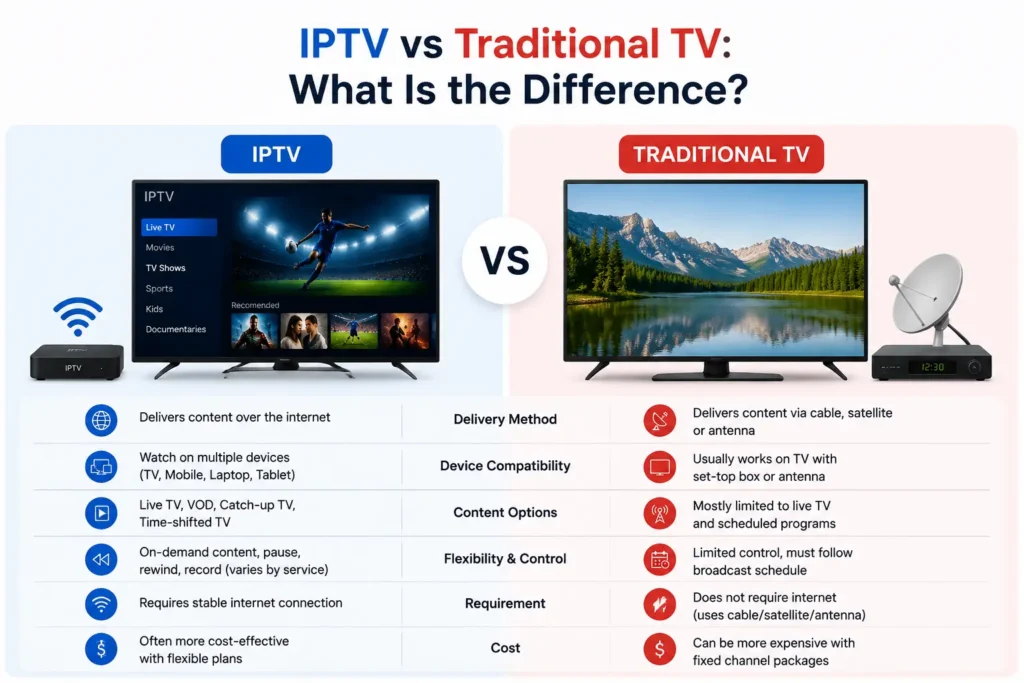
IPTV and traditional TV both deliver video content, but they work in very different ways. Traditional TV usually depends on satellite signals, cable networks, or terrestrial broadcast systems. IPTV uses internet protocol networks to deliver content digitally.
One of the biggest differences is control. Traditional TV is mostly schedule-based. The viewer watches what is available at that moment. IPTV gives more control because users can choose live channels, replay content, or watch videos on demand.
Another difference is device flexibility. Traditional TV often requires a television set and a cable or satellite receiver. IPTV can work on Smart TVs, Android devices, phones, tablets, computers, and streaming boxes. This makes it easier for people to watch content at home or while traveling.
IPTV can also provide a more personalized experience. Many IPTV platforms organize channels by country, category, language, or content type. Users can access sports, movies, kids’ content, news, documentaries, and international channels from one interface.
Traditional TV is often more stable because it does not depend on home internet speed in the same way IPTV does. However, IPTV can offer more flexibility and wider access when the internet connection is strong.
IPTV vs Cable TV
Cable TV delivers channels through physical cable infrastructure. It has been widely used for many years and is still common in many homes. IPTV, on the other hand, uses internet connectivity.
Cable TV usually comes with fixed packages. Users may pay for a bundle of channels, even if they only watch a few of them. IPTV services often provide more flexible content categories, depending on the provider.
Cable TV may require installation, wiring, and a specific receiver. IPTV usually requires only an internet connection, a compatible device, and an IPTV app or player. This makes IPTV easier to set up in many cases.
IPTV vs OTT Streaming Services
Many people confuse IPTV with OTT streaming services. OTT stands for “over the top.” Services like subscription-based movie and series platforms are examples of OTT streaming. They deliver content over the internet without needing a traditional TV provider.
IPTV and OTT both use the internet, but they are not the same. IPTV often provides live TV channels, EPG, catch-up TV, and television-style packages. OTT platforms usually focus more on on-demand movies, original series, and app-based entertainment.
Best Devices for IPTV
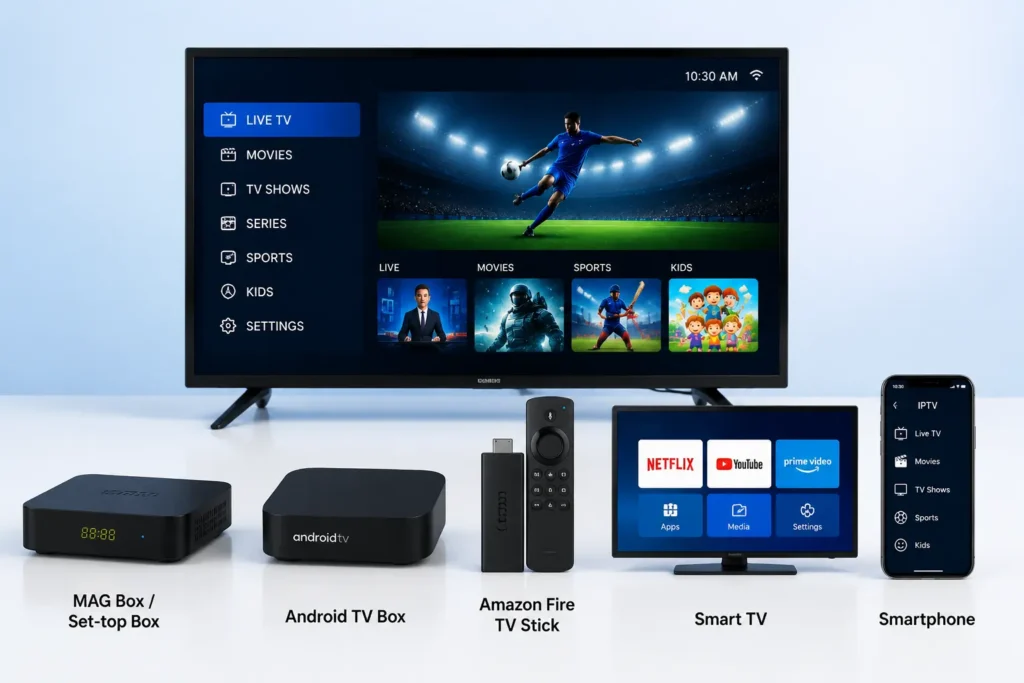
One reason IPTV has become so popular is that it works on many different devices. The best IPTV device depends on the user’s budget, location, app preference, and viewing habits.
Smart TVs
Smart TVs are one of the easiest ways to watch IPTV. Many modern TVs support IPTV apps that can be installed directly from the app store. Users can open the app, add their IPTV login details or playlist, and start watching.
Smart TVs are convenient because they do not always require extra hardware. However, app availability depends on the TV brand and operating system. Some TVs have better app support than others.
Android TV Boxes
Android TV boxes are popular for IPTV because they support many apps and media players. They connect to the television through HDMI and use Wi-Fi or Ethernet for internet access. Many users prefer Android boxes because they are flexible, affordable, and easy to customize.
A good Android TV box can handle live TV, VOD, EPG, and high-definition streaming. For better performance, users should choose a device with enough memory, updated software, and stable network support.
Fire TV Devices
Fire TV devices are widely used for streaming and IPTV apps. They are compact, easy to connect, and user-friendly. Many IPTV users prefer them because they work well with different streaming applications.
The performance depends on the model, internet speed, and installed apps. A stronger device usually provides smoother playback, faster navigation, and better handling of high-quality streams.
Apple TV
Apple TV is known for smooth performance, a clean interface, and strong app quality. It can be a good option for users who already use Apple products. Some IPTV apps are available for Apple TV, although app selection may vary by region.
Apple TV is usually more expensive than many Android-based options, but it offers a premium user experience.
Smartphones and Tablets
IPTV can also be watched on Android and iOS phones or tablets. This is useful for people who travel, commute, or want entertainment away from the main TV screen.
Mobile IPTV apps allow users to watch live channels, movies, and series anywhere with a stable internet connection. However, watching for long periods on mobile data can consume a large amount of bandwidth.
Computers and Laptops
Users can watch IPTV on Windows, macOS, or Linux computers through media players, web portals, or compatible IPTV applications. This option is useful for people who prefer watching on a larger monitor or need keyboard-based navigation.
A laptop can also be connected to a TV through HDMI if the user wants a bigger screen experience.
Important Features of a Good IPTV Service
Not all IPTV services are the same. A good IPTV experience depends on several features.
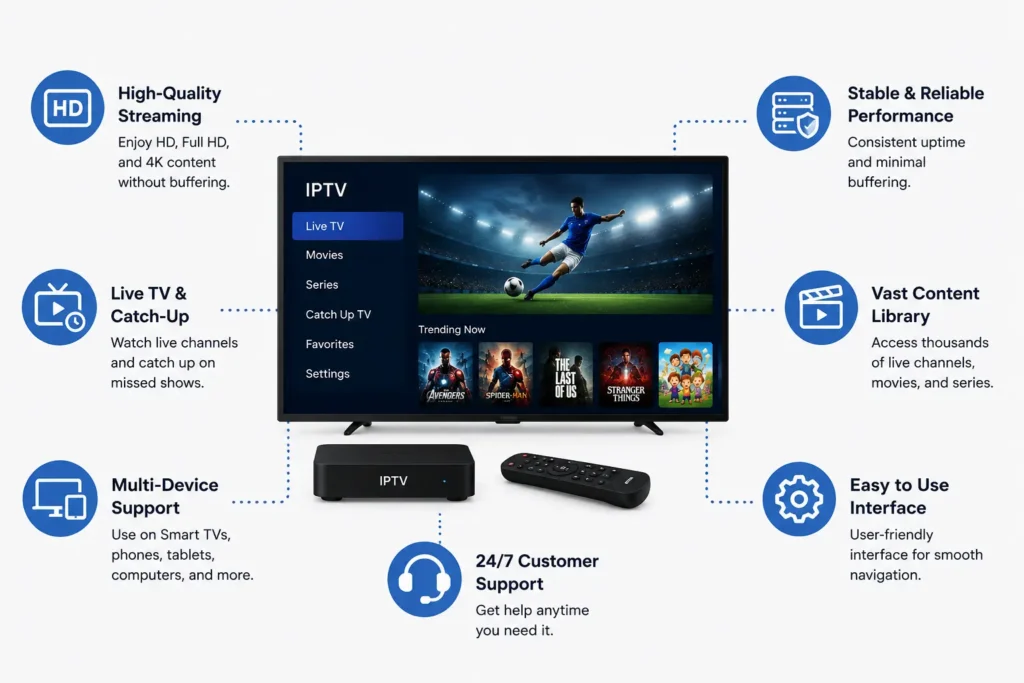
A reliable IPTV service should offer stable streaming with minimal buffering. Channel quality is important, especially for sports, live events, movies, and news. The service should also have a clean and organized channel list.
An electronic program guide is also useful. EPG helps users see what is currently playing and what is coming next. This makes IPTV feel more like a complete television experience.
VOD quality matters as well. A strong IPTV platform may include movies, series, documentaries, and updated content libraries. Good categorization helps users find content easily.
Customer support is another important factor. If users face login issues, buffering problems, app setup confusion, or device compatibility questions, helpful support can make a big difference.
Security and legality should also be considered. Users should choose services that respect content rights, privacy, and safe payment practices.
Is IPTV Legal?
IPTV technology itself is legal. It is simply a method of delivering television content through the internet. Many legitimate companies, broadcasters, telecom providers, and streaming platforms use IPTV technology.
However, the legality of a specific IPTV service depends on whether it has permission to distribute the content it offers. A legal IPTV provider has proper licensing rights for channels, movies, sports, and other programming. An unauthorized provider may offer copyrighted content without permission, which can create legal and security risks.
Benefits of IPTV
IPTV offers several advantages over traditional television. The first major benefit is flexibility. Viewers can watch content on different devices and often choose when they want to watch.
The second benefit is content variety. IPTV can include live TV, movies, series, sports, documentaries, and international channels in one place.
The third benefit is convenience. Users may not need complicated installation, satellite dishes, or long cable contracts. In many cases, IPTV setup can be completed with an app and an internet connection.
The fourth benefit is better control. Features like VOD, catch-up TV, time-shifted content, EPG, favorites, and search make the viewing experience more user-friendly.
The fifth benefit is global access. IPTV can make it easier for users to watch content from different countries, languages, and regions.
Disadvantages of IPTV
IPTV also has some disadvantages. The biggest one is dependence on internet quality. If the internet connection is weak, the streaming experience can be poor.
Another disadvantage is service reliability. Some providers may have unstable servers, poor support, or outdated channel lists. This can lead to buffering, broken links, and missing content.
Device compatibility can also be an issue. Not every IPTV app works on every device. Some users may need help setting up the right app or player.